
Air Duct Cleaning: Repair or Replace? How Casa View Homeowners Decide
Most Casa View homeowners call us with the same question: “Do my ducts need cleaning, repair, or full replacement?” Here’s the short answer. If your ducts are connected, sealed, and structurally sound, you need cleaning. If they’re leaking at the joints or have separated sections, you need repair and sealing. Full replacement is the last resort, reserved for collapsed trunks or ductwork that’s failing throughout the entire system. The order matters, and getting it wrong wastes money either way.
We put together this guide because we’ve seen too many Casa View homes where someone paid for a thorough cleaning on a duct system that was dumping conditioned air into the attic the whole time. Let’s sort out how to tell the difference before you spend anything.
Cleaning, Repair, or Replace: Start With the Right Question
The order of operations is what most homeowners get wrong. Cleaning is a maintenance step. Repair and sealing are a structural fix. Replacement is a rebuild. Each solves a different problem, and doing them in the wrong order means paying twice.
Think of it this way. If a duct joint is disconnected in your Casa View attic, every minute the system runs, it’s pulling attic air into the supply side and pushing conditioned air out through the gap. Cleaning that system without sealing it first is like mopping a floor while the faucet is still running. The contamination comes right back.
A sensible decision framework looks like this:
- Clean only when ducts are intact, connected, and reasonably sealed, but have visible buildup or a musty smell.
- Repair and seal when joints are separated, flex duct is torn or crushed, or the plenum connections have gaps.
- Replace when the trunk line has collapsed, the duct layout is fundamentally wrong, or the damage spans most of the system.
In our experience across Casa View, the clean-only category is smaller than most people expect. Homes built in the 1980s and 1990s often have flex duct that’s been baking in a hot attic for decades, and that material degrades. Older homes with metallic ductwork tend to fail at the joints where sections connect. Neither problem goes away with a vacuum.
What a Proper Inspection Should Actually Check
A real inspection goes well beyond shining a light into a vent and saying “yep, it’s dirty.” The technician should be evaluating the system’s structure, not just its surfaces. If an estimate is based only on what’s visible from a supply register, it’s incomplete.
Here’s what a thorough assessment covers in a Casa View home:
- Duct material and condition – Is the flex duct intact, or is the inner liner torn and collapsing? Are metal ducts still joined properly?
- Joint and seam integrity – Every connection between duct sections, and the connection to the plenum and registers, gets checked for gaps.
- Trunk line continuity – Is conditioned air actually reaching the far end of the run, or is it leaking out along the way?
- Insulation condition – Ducts running through a hot attic need intact insulation, or the air arrives warm.
- The air handler and plenum – The equipment cabinet and the transition to the ductwork are common leak points.
- Contamination type – Surface dust and debris are one problem. Moisture-driven biological growth is a different one, and it’s handled differently.
That last point trips people up. Duct leakage and biological contamination are two separate issues. Leakage is a pressure and efficiency problem. Contamination is an air quality problem. A system can have terrible leakage with perfectly clean ducts, or tight, well-sealed ducts with a musty smell coming from one damp section. Confusing the two leads homeowners to buy the wrong service.
If you’d rather have a trained eye look at it, call (888) 886-6271. We answer 24/7. Fast dispatch from 7am to 7pm, Sunday through Friday.
Common Duct Failure Points by Home Age in Casa View
The age of your Casa View home tells you a lot about where problems are likely hiding. Construction practices changed significantly over the decades, and each era has its own weak spot. Knowing yours helps you ask better questions.
1980s and 1990s construction is where we see the most flex duct degradation. Flex duct was fast and cheap to install, and it was used generously. The problem is that the inner liner is thin, and after years of hot attic temperatures and the flexing that comes with every HVAC cycle, it tears. Once the liner is compromised, the duct leaks at a much higher rate, insulation gets saturated, and the whole run becomes a problem. In these homes, cleaning without addressing the flex duct condition is often money poorly spent.
Older homes with metallic ductwork fail differently. The metal itself holds up well. What gives out is the joining. Sections that were connected with tape or friction fittings separate over time, especially where the duct passes through a hot attic or where vibration from the air handler works a joint loose. These are usually repairable. Metal ducts can be resealed and put back into service.
Newer construction isn’t immune either. Poorly sealed plenums and loose register boots are common across every era, and they’re among the biggest leaks in the system because they’re closest to the equipment.
In our experience, the single most useful thing a Casa View homeowner can do is understand which era their ductwork came from. It narrows the conversation from “should I clean or repair” to “what’s most likely failing, and what’s the fix.”
Clean and Seal: How the Combined Service Actually Works
When repair and cleaning are done together, the sequence is deliberate. You seal or repair the structural problems first, then clean the now-sealed system, then treat it. That order is what makes the results last.
There are three main approaches to sealing, and each fits a different situation:
- Mechanical repair handles the obvious failures. A separated joint gets reconnected. A crushed flex run gets replaced. A damaged plenum connection gets rebuilt. This is the foundation, and it’s done before anything else.
- Mastic application is a sealant brushed or troweled onto accessible joints, seams, and connections. It’s durable and it works well in attics where the technician can reach the ductwork. Most residential sealing projects lean heavily on this.
- Aeroseal is a different method: a sealant mist is pushed through the duct system itself, and it settles into the small leaks you can’t physically reach. It’s useful when leaks are hidden in wall chases or behind finished surfaces. It isn’t a substitute for mechanical repair on a fully disconnected run, but it closes the small gaps that mastic can’t get to.
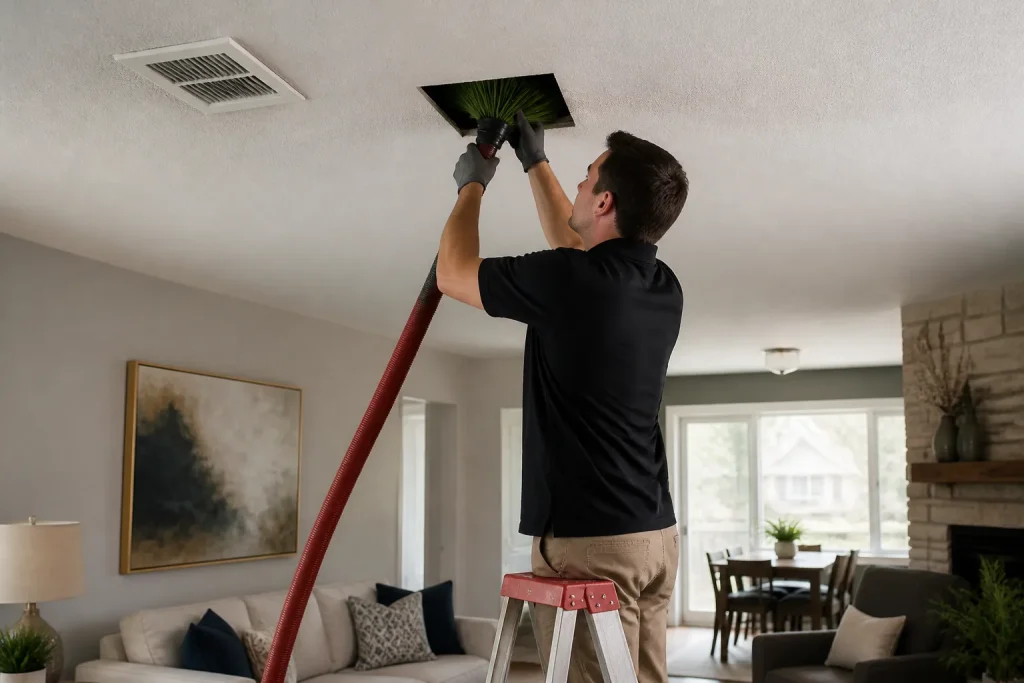
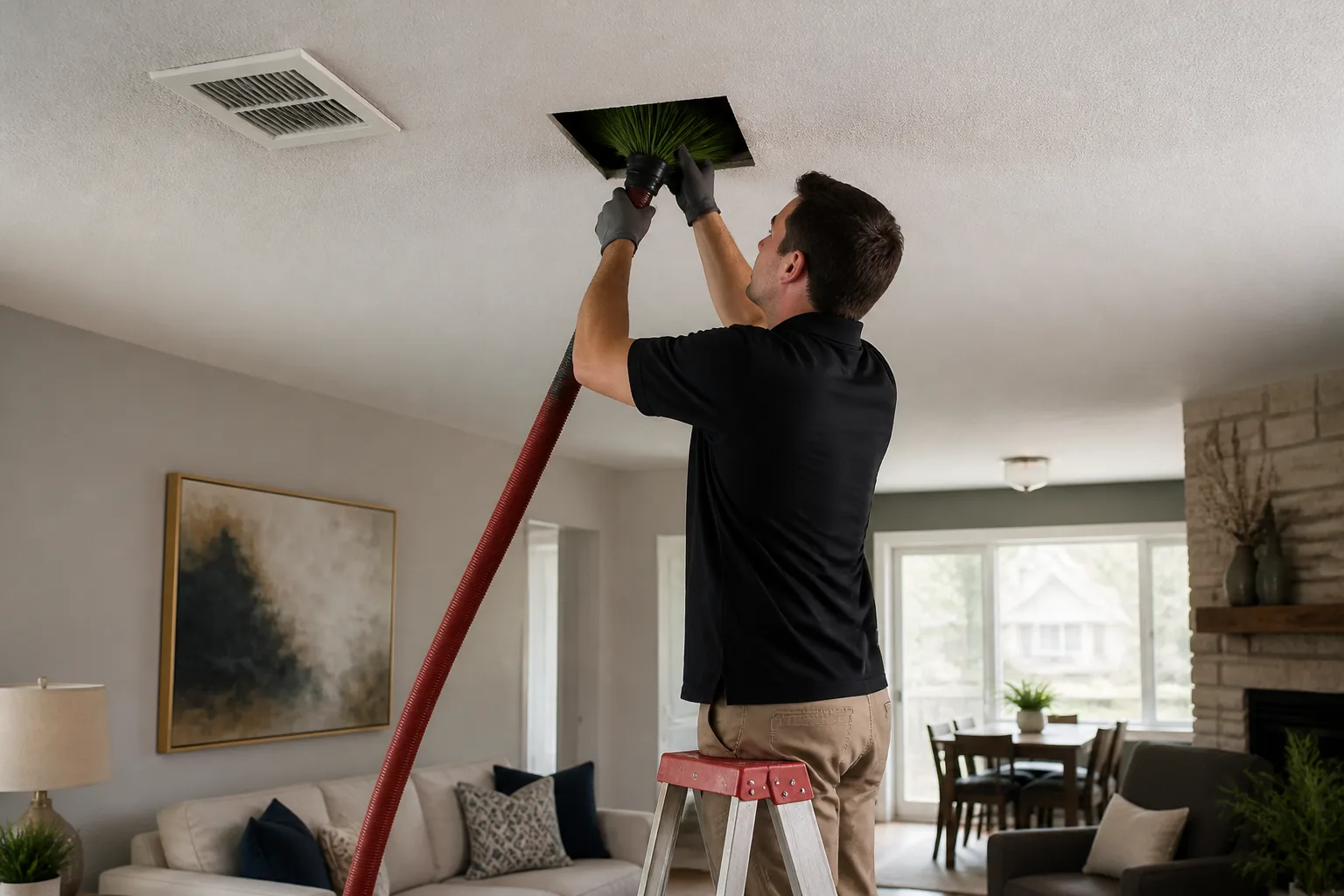
After repair and sealing, the cleaning phase uses contact cleaning and mechanical agitation, not just a vacuum hose pointed at a vent. Our technicians use Rotobrush contact-cleaning systems and Nikro industrial vacuums to agitate and remove buildup from duct walls, then Abatement Technologies air filtration captures the dislodged material on-site so it doesn’t recirculate through your Casa View home during the job. That’s on-site containment, and it’s a meaningful difference from a portable blowout.
Once the system is clean and sealed, an antimicrobial sanitizing treatment, like the Guardsman products we use, addresses the surfaces the cleaning touched. The system is treated, not just cleaned.
Is It Worth Repairing, or Should You Replace?
The cost-benefit question comes down to scope. Repair and sealing make sense when the damage is localized. Replacement makes sense when the system’s basic design or condition is beyond saving. Here’s the framework we walk homeowners through.
Lean toward repair and seal when:
- The duct layout is sensible and reaches every room it should.
- The trunk line is intact and continuous.
- Damage is concentrated at flex runs, joints, or plenum connections.
- The air handler and equipment are in good working order.
In these cases, sealing and repair can extend the life of the system considerably, and the added expense is justified because you’re fixing the actual problem rather than cleaning around it.
Lean toward replacement when:
- The trunk line has collapsed or is failing along most of its length.
- The duct design itself is inadequate, with rooms that never got proper supply runs.
- Flex duct degradation is widespread rather than isolated.
- Repair after repair keeps coming back to the same failing sections.
The honest answer is that replacement is rarer than the internet suggests. Most Casa View homes we look at fall into the repair-and-seal category once the actual failures are identified. If you want a technical read on your specific system, rather than a guess, that’s exactly what an inspection is for.
Related services in Casa View
If your inspection points toward cleaning and repair, you’ll want to look at air duct cleaning for the full-system process. If your system’s air handler and coils also need attention, HVAC cleaning covers the equipment side. And if you’re already scheduling service, dryer vent cleaning addresses a fire risk that air-duct-only providers routinely miss.
When to Call a Pro
Some of this you can check yourself. Look for visible gaps where ducts connect, feel for air escaping at joints with the system running, and note any musty smell that returns after a cleaning. Those are all signs it’s time for a professional assessment.
What you shouldn’t do is climb into the attic and start reconnecting flex duct or sealing joints yourself. Attic work carries real hazards, and a sealant that isn’t rated for ductwork can cause problems of its own. This is also where the bigger picture matters: Roto brush cleaning, sealing, and sanitizing as one coordinated job needs proper equipment and on-site containment, and doing it in pieces tends to leave gaps.
When you’re ready, we handle all five services under one company and one visit: air duct cleaning, dryer vent cleaning, HVAC cleaning, air quality and sanitizing, and duct repair and sealing. That last one is in-house, so a leaking duct doesn’t mean calling a second contractor or booking a second appointment. We can also assess your overall air quality system and talk through Honeywell and Aprilaire options if you’re thinking beyond a one-time cleaning. Our technicians have up to 10 years of experience with this equipment.
The Bottom Line
Cleaning a structurally failing duct system wastes money. Repair and seal first, then clean, then treat. In Casa View, flex duct from the 1980s and 1990s is the most common failure point, and older metallic systems usually need joint work rather than full replacement. Get a real inspection, understand your home’s era, and let the findings drive the decision.
If you’re in Casa View and need help, Air Duct Cleaning Casa View offers free estimates, call (888) 886-6271. We answer 24/7. Fast dispatch from 7am to 7pm, Sunday through Friday.
Frequently Asked Questions
Whole-system air duct cleaning is priced per job from a written estimate, not per vent, because the cost depends on the size of the system, the number of runs, and whether repair or sealing is included. A free estimate is the only reliable way to get a firm number. Call (888) 886-6271 for an exact quote, estimates are free.
Low quotes often cover only a vacuum pass at the registers, with no contact cleaning, no containment, and no inspection of the duct structure. That leaves the buildup on the duct walls and skips the leaks entirely. A proper job uses mechanical agitation and on-site filtration, which is a different scope of work. Call (888) 886-6271 to compare what’s actually included.
Ask for before-and-after documentation and ask what equipment is used on the job. Contact cleaning with systems like Rotobrush and industrial vacuums like Nikro leaves clear evidence of the difference, and containment with Abatement Technologies on-site filtration shows the process is designed to capture contaminants rather than spread them. Call (888) 886-6271 and we’ll walk you through what a full-service visit includes.
Most homes benefit from cleaning every few years, and sooner after a renovation, a move into an older home, or when ducts show visible buildup or a persistent musty smell. In a Casa View home with aging flex duct, the inspection matters more than the calendar. Call (888) 886-6271 for a free estimate and a straight answer on timing.
Written by the team at Air Duct Cleaning Casa View.
Need Air Duct Cleaning Help?
Call Air Duct Cleaning Casa View - the local pro we connect you with is licensed and insured, here with fast help in Casa View.
(888) 886-6271